about | bio | statements
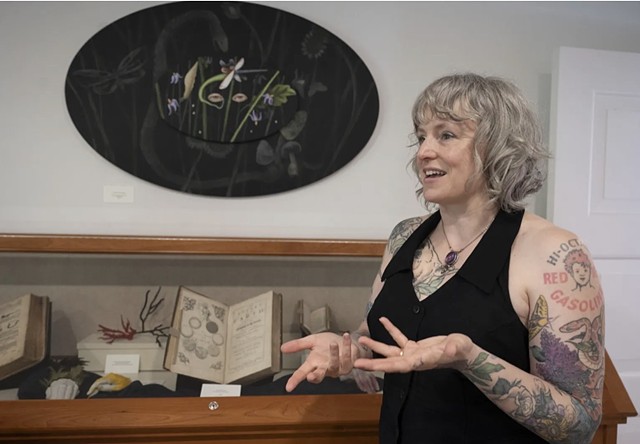
Lauren Levato Coyne speaks about the work in her solo exhibition Medusa's Bestiary: Embodiments and Ecologies at the Kinney Center for Interdisciplinary Renaissance Studies in Amherst. CAROL LOLLIS / Hampshire Gazette Staff Photo, 2026
BIOGRAPHY
Lauren Levato Coyne (she/they) is a queer artist, writer, and eco/sci-art educator.
Her paintings, drawings, and sculptures have been exhibited widely in print as well as galleries and museums. Her exhibition history includes the Chicago Cultural Center, Cranbrook Art Museum, Shelburne Museum, The International Museum of Surgical Science, Hashimoto Contemporary, Wasserman Projects, Audubon Magazine, Denver Quarterly, UMass Amherst, and more. She has received grants and fellowships from Cranbrook Academy of Art, Chicago Cultural Council, Massachusetts Cultural Council, Ragdale, Taconic Foundation, and others.
Levato Coyne's writing appears in Antennae: Journal of Nature and Culture; Boston Art Review, Berkshire Eagle; Brooklyn Rail; Gulf Coast Journal; Material Intelligence; Sculpture Magazine, and others. Levato Coyne was named the 2026 recipient of the AICA-USA Irving Sandler Award for New Voices in Art Criticism. Additionally she is the recipient of a Toni Beauchamp Prize in Critical Arts Writing, a Rabkin Foundation travel grant, and a Vermont Studio Center dual writing and painting fellowship, among others.
Levato Coyne has been a visiting artist or visiting critic at The Clark Art Institute, The Field Museum, Georgia State University, Rhode Island School of Design, The School of the Art Institute of Chicago, University of Illinois at Urbana-Champaign, and University of Wisconsin among others. She currently teaches the Drawing Science Studio Lab at Williams College and at RISD she teaches ENTANGLEMENTS, a graduate seminar on art, ecology, gender, and class. She has previously brought her STEAM education to the artists at Community Access to the Arts, a community arts organization for artists living with disabilities.
Levato Coyne earned an MFA in painting from Cranbrook Academy of Art. She holds undergraduate degrees in professional writing; literature; and gender and ethnic studies from Purdue University and a certificate in political journalism from Georgetown University.
GENERAL ARTIST STATEMENT
My visual work consists primarily of drawing, painting, and sculpture. My writing has taken many forms, but I am primarily an essayist. Finally, I am a STEAM educator working at the university and community levels. All of this work is rooted in the ecological imagination. Read on for more specifics about each type of work.
In my 2D and 3D work, the ecological imagination acts as a hybrid zone with porous margins. This allows scientific observation to blend with intuitive leaps of logic and storytelling. My work is influenced by natural history, art history, literature, and eco-theory. I employ a fractured, fairy-tale type of logic to explore the stories we tell about nature, interspecies connection, hybridization, and transformation.
My eco-arts writing stems from a similar place. I am trained as a political journalist and spent a decade working as a daily news reporter. That time was an influential training ground for how to think, research, and develop a narrative. Now, I primarily write creative nonfiction grounded in art, climate change, species loss, and the related issues of misogyny, racism, and classism.
MEDUSA'S BESTIARY an on-going project
I was the artist in residence at the Kinney Center for 2026 where I conducted research and translations that helped inform my solo exhibition there. Medusa’s Bestiary: Embodiments & Ecologies is on view at the Kinney Center for Interdisciplinary Renaissance Studies from September 2026-May 2027.
After her head was cleaved from her body, Medusa’s bemonstered blood spontaneously generated creatures of both myth and matter. First were her twins, the legendary winged horse Pegasus followed by lesser-known Chrysaor, a giant with a boar’s head and a golden sword. Next came their seafloor sibling red coral, a very real and now overharvested animal sold as a portafortuna contro il malocchio—a good luck charm against the evil eye. But after these known abiogeneses—and after her head was carted off—what happened to Medusa’s body? With Medusa’s Bestiary, I propose her body continued to spontaneously produce “endless forms most beautiful and most wonderful,”* giving rise to an entire ecosystem that is still unfolding today.
Inspired by early modern naturalists, fabulists, and artists, Medusa’s Bestiary explores and documents the speculative ecosystems generated from Medusa’s abandoned body. Instead of the fabled garden of stone statues, this New Gorgonia is home to a host of flora and fauna including hybrids, mutants, monsters. Beyond the speculative, and following in the footsteps of early naturalists and mythmakers alike, there are also existing plants and animals that this project claims as Gorgonian in lineage. Stone-skinned creatures, such as seahorses, beetles, and spiders belong in this new taxonomy. Swamp things and blood drinkers too, from carnivorous plants and frogs to vampire moths and bats. Mirrored animals—literally as well as those who appear as their own double/twin—are also part of the Gorgonian taxon, from the reflective sequined spider to double-headed snakes and lizards.
Then there are the species that early modern artists depicted as part of Medusa’s legacy, such as the fire salamander in Peter Paul Rubens’ painting The Head of Medusa (1618). During my research at the Kinney Center, I realized another connection: the two-headed lizard in the lower middle portion of the painting—just below the line of her severed head and next to a small snake emerging from a droplet of blood—is the U-shaped polycephalic amphibian depicted in Adam Lonicer’s Kreuterbuch.** These “creeping things,” a phrase often used in the early modern period, have always felt like my own non-human kin, familiar and relatable, much like Medusa herself.
* Edward O. Wilson, ed. From So Simple a Beginning: The Four Great Works of Charles Darwin (New York, W. W. Norton & Co, 2006), 760.
** Lonicer, Adam. Kreuterbuch. (Frankfurt am Main: Heirs of Christian Egenolph). 1564.